
TCS AI for Business Study: Key Findings Report
This report from Tata Consultancy Services explores the potential and performance of AI in business applications.
TCS AI for Business Study Key Findings Report From potential to performance by design
Contents Foreword: K. Krithivasan CEO, TCS How AI is redefining business The transforma�ve poten�al of AI for business The current state of AI Top challenges for AI implementa�ons Future of AI Turning AI’s poten�al into performance TCS AI methodology The TCS approach Study demographics 03 04 06 14 20 27 50 35 49 47
FOREWORD Reimagine your business with AI by K. Krithivasan CEO, Tata Consultancy Services I am delighted to release this TCS AI for Business Study key findings report, which shows the majority of senior executives are optimistic about AI’s potential impact on their business and 94% have active plans or have deployed it already in their business – showcasing the fast penetration of this technology wave. This report shares this and other unique insights about how organizations around the world in every industry are responding to AI’s transformative potential. This study contains perspec�ves from nearly 1300 senior leader s from 24 countries, making it one of the largest surveys of its kind, and con�nuing TCS’ commitment to use our posi�on of privilege of working with the world’s leading corpora�ons to unlock the collec�ve knowledge we all have, and create an ecosystem of insights and learning. The latest evolu�on of ar�ficial intelligence—with its genera�ve AI capabili�es—has the poten�al to help companies reimagine en�re value chains, experience pervasive performance improvements, and create new ways of working. At the same �me, the findings from our AI study, as well as our own experience working with large organiza�ons, show that most companies are also thinking of how to balance risk with opportunity as they move forward with their AI strategy . Interes�ngly an overwhelming 81% of the leaders polled have asked for a more ‘global’ set of regula�ons and standards on AI. Right now, most organiza�ons use AI to assist humans. As it matures, we will increasingly see AI used to augment human ac�vi�es and ul�mately, transform businesses by eleva�ng human thinking with the ability to ideate based on machine output. According to the study, most execu�ves think human crea�vity or their strategic thinking will be an essen�al compe��ve differen�ator in the next three to five years. AI can help scale this crea�vity to new, unprecedented levels . The study also shows that to fully leverage the latest wave of AI and mi�gate its risk, nearly three-quarters of companies are already revamping their strategy or opera�ng model . It’s not surprising that many organiza�ons are yet to create an effec�ve long-term AI strategy and KPIs, given the con�nual and rapid pace of change in its evolu�on. AI is crea�ng an unprecedented opportunity for organiza�ons around the world to capitalize on their unique contextual knowledge to elevate and maintain elite performance. And at TCS we are proud to be part of the AI revolu�on, collabora�ng with companies to help them effec�vely create an industry-led, ecosystem-enabled and data-fueled “enterprise-wise” founda�on that by design, turns the poten�al of AI into sustainable performance. I am very proud of the TCS contributors who worked on this study, our clients and partners who contributed generously with perspec�ves, and I hope this unique research will add to the evolu�on of our thinking, bringing a fresh, data-driven perspec�ve to the larger AI conversa�on.
INTRODUCTION How AI is redefning ̃bout the study In early 2024, the TCS Thought business Leadership Ins�tute conducted a comprehensive global survey on the The latest wave of ar�ficial intelligence is state of AI adop�on and its impact on not only reshaping the landscape of society, businesses across various industries. it also offers new opportuni�es to radically reinvent the way we do business. The The study surveyed nearly 1,300 CEOs emergence of genera�ve AI combined with and other senior execu�ves with P&L tradi�onal AI can now elevate human responsibility. The companies spanned contribu�ons in business and empower 12 industries and 24 countries around organiza�ons to get the most value from the globe. About half the companies their unique data. have annual revenue between US $1 billion to $5 billion and the other This comprehensive research report from half have over US$5 billion in revenue. the TCS Thought Leadership Ins�tute reveals a posi�ve sen�ment around AI from We also wanted to understand what the most execu�ves. In fact, the majority said most financially successful companies in they are op�mis�c about the poten�al our survey are thinking and doing impact of AI on their business. Most senior around their AI strategy; where leaders also believe that AI will con�nue to relevant, we compare them to other assist and augment human ac�vi�es in the respondent companies. Throughout this next few years, not replace them in the report we refer to these top performers workplace. And while the daily use of GenAI as Pacese�ers while Followers are the by employees is expected to increase, less successful companies. human crea�vity and strategic thinking will remain essen�al for compe��ve differen�a�on. A discovery from the research was that although corporate leaders see the value of inves�ng in AI, most of them lack a cohesive strategy or ways to measure the success of their AI implementa�ons—which may not be wholly surprising, given the accelerated pace of AI’s con�nued evolu�on. Yet it will likely be challenging to get boardroom buy-in for AI implementa�ons without success metrics. Company leaders recognize, too, that to fully leverage all that AI has to offer, they will need to make big changes to their business models—and to their infrastructure. Managing a culture of AI-readiness and talent development also ranks high for organiza�onal leaders. This report reveals these and other insights from leaders of large enterprises around the world in nearly every industry. The report represents a comprehensive overview on the state of AI for business leaders. It gives us very good insights on what's important for corpora�ons right now, with the dawn of GenAI, like what companies are focusing on for AI, how companies expect AI will impact their business, and what companies expect governments to do in the global regulatory landscape. It is a must read for companies crea�ng a strategy for AI. – Claudionor N. Coelho Jr, PhD/MBA, Chief AI Officer, Zscaler, Inc. TCS AI for Business Study Key Findings Report 04
How are CEOs and other senior decision makers around the world responding to AI’s transforma�ve poten�al? How are they managing their AI strategy? As the pace of ar�ficial intelligence accelerates, is their organiza�on AI-ready? Do they understand the poten�al value of AI for their business? Are they balancing those opportuni�es with the risk? Will they manage AI implementa�ons in-house or work with a technology partner to chart their unique approach to AI? AI can make companies more produc�ve and profitable. But can it also make them be�er? The study inves�gates: The research explores: Top business objec�ves driving AI implementa�ons Planned direc�on for AI strategy Current organiza�onal state and percep�ons around AI and associated KPIs How much AI is expected to enhance overall business performance Implica�ons for employee experience, skills and roles Impact to customer engagement and crea�ng be�er customer experiences AI DEFINED For this study, AI is defined as Genera�ve AI, as well as more established AI tools such as predic�ve analy�cs and forecas�ng, personaliza�on and recommenda�on engines, robo�cs, intelligent automa�on, simula�ons, machine learning, and more. The report contains unique insights and direc�onal informa�on for top execu�ves seeking to navigate through the hype more effec�vely and lead their enterprise into the rapidly evolving Era of AI. TCS AI for Business Study Key Findings Report 05
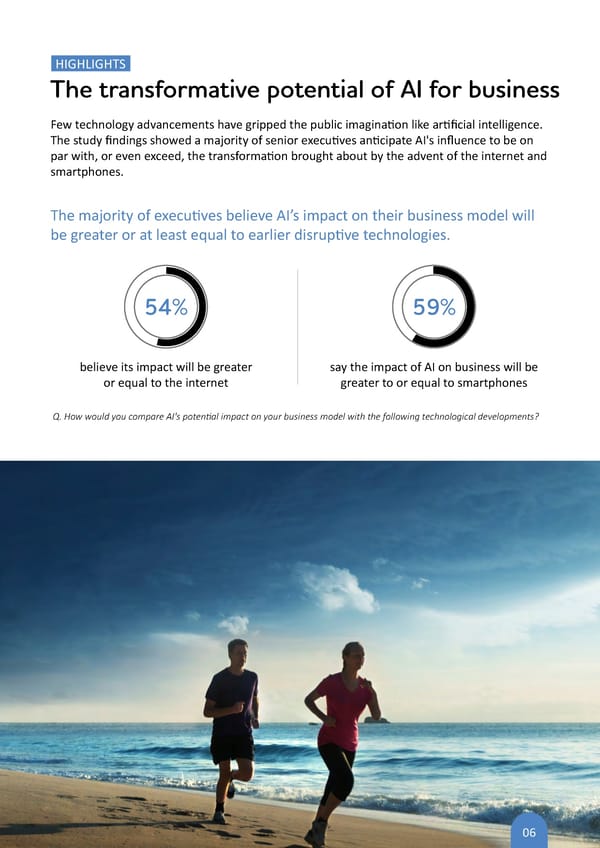
HIGHLIGHTS The transformative potential of AI for business Few technology advancements have gripped the public imagina�on like ar�ficial intelligence. The study findings showed a majority of senior execu�ves an�cipate AI's influence to be on par with, or even exceed, the transforma�on brought about by the advent of the internet and smartphones. The majority of execu�ves believe AI’s impact on their business model will be greater or at least equal to earlier disrup�ve technologies. 54% 59% believe its impact will be greater say the impact of AI on business will be or equal to the internet greater to or equal to smartphones Q. How would you compare AI's potential impact on your business model with the following technological developments? 06
This is a modal window.
Global execu�ves are also op�mis�c about the poten�al of AI to transform their business. AI holds the promise of reshaping opera�ons, crea�ng new value chains, and redefining the customer experience. The industries most op�mis�c 57% about AI’s poten�al: Banking, Financial Services & Insurance Technology Manufacturing say they are excited or op�mis�c about AI’s poten�al impact on their business Q. Which of the following is closest to how you’re feeling about AI's potential impact on your business? We believe that strategic AI implementa�ons, such as those made possible with Google's Gemini family of models, with its poten�al for complex reasoning and mul�-modal capabili�es, will drive business growth, innova�on, and produc�vity gains by augmen�ng human capabili�es. To realize the outcomes of this in-depth study by TCS, by leveraging Google Cloud AI's comprehensive solu�ons, enterprises can implement innova�ve genera�ve AI to achieve be�er agility, responsiveness, and resilience, leading to improved efficiency and new ways of working. This has the poten�al to improve almost every aspect of day-to-day work, tackling complex tasks and genera�ng more insigh�ul and innova�ve outputs at a much faster rate. – Dr. Ali Arsanjani, Director, AI/ML Partner Engineering, Google Cloud TCS AI for Business Study Key Findings Report 07
Success story #1 Real-world AI implementa�on: A masked interview with a large enterprise Drilling down to what customers want and need AI capabili�es enable large mining company to experience greater revenue from subscrip�on services, improve forecast accuracy through a 20% reduc�on in error rates, and gain greater customer sa�sfac�on Country: Sweden Type of company: Mining machines manufacturer Role: Head of AI & Automa�on Revenue: USD $10 billion to less than $20 billion Overview This Swedish firm has seen significant benefits from AI, including predic�ve and genera�ve AI. It regards AI in a kind of “opportunity radar” with four quadrants. In the first quadrant, AI is part of the products and services the company buys (for example, GitHub, Microso� Copilot, other off-the-shelf offerings). More and more of these in the future will be infused with AI. Its second quadrant is customer experience, which is more likely to include genera�ve AI solu�ons. The third quadrant focuses on internal efficiencies, like the supply chain, using AI for quality inspec�on, demand forecas�ng, and so on. The fourth quadrant is the compe��ve differen�ator: pu�ng AI into the products. The company has more than 1,200 mining machines that Last year, a�er ChatGPT came in, people were head over heels. They said, 'Oh, what can we do around AI?' And I'm like, come on, let's start with the ‘business why.’ If we do anything, it's always like, 'Why am I doing this? What business problem am I trying to solve? What is my top business challenge? What am I trying to do here?' So you start always with design thinking and all of that. Of course, you need an ecosystem of all the technologies and pla�orms available at your disposal to resolve those business challenges. But it's not the other way around that you have targets around AI that, 'I want to do ten use cases.' It doesn't help, right?... [We should] focus more on the game-changing AI where you talk about innova�on. ‘Do you know how you differen�ate [us] from the compe��on?’ That's where we want to invest. are connected to AI and use it for predic�ve and prescrip�ve maintenance. This allows the company to proac�vely provide a solu�on before the machines fail and helps protect workers deep in the mines. When they sell their machines to mining companies, their predic�ve maintenance op�ons is one of the strongest use cases for AI—but, as this execu�ve indicated, there are many more benefits. For example, with AI-enhanced demand forecas�ng, they’ve seen a 20% improvement in error rates. They’ve also found higher revenue and sales by moving from selling products to offering AI-driven product-service bundles, which reduces down�me and offers cost-saving benefits for customers. TCS AI for Business Study Key Findings Report 08
Business objec�ves Reduce high net working capital (NWC) by focusing on sales forecas�ng, demand planning, and inventory planning Convert machine sales into product-service subscrip�on revenues Use KPIs to focus on performance improvements, minimize down�me, and increase customer sa�sfac�on using a remote monitoring service. (For example, use predic�ve AI to proac�vely improve maintenance of machines and safety of workers, and to prevent unnecessary machine maintenance by customers) Benefits and implica�ons of AI implementa�ons Transforming the company from a product sales organiza�on to a bundled product-service subscrip�on business. Predic�ve maintenance has generated revenue through so�ware subscrip�ons and increasing machine sales while ensuring sustainability by op�mizing servicing schedules, reducing down�mes and crea�ng cost-savings for customers. Measurable performance gains in demand forecas�ng, with a 20% reduc�on in error rates, enhancing forecast accuracy. Greater innova�on within the organiza�on's specific areas, par�cularly in predic�ve maintenance, recondi�oning plants, and produc�on line automa�on. AI is playing a vital role in improving produc�vity and quality inspec�on processes, which ul�mately enhances the overall quality of products. With Genera�ve AI, customers can address a substan�al por�on of issues independently, diminishing the need for a large service technician workforce. Sa�sfied customers result in higher sales and subscrip�ons, further boos�ng revenue. The integra�on of AI into ERPs is also an�cipated to enhance internal efficiencies. AI is differen�a�ng the company from its compe�tors, promp�ng strategic considera�ons of building versus buying AI solu�ons. Lessons learned Leverage edge compu�ng for data access Get buy-in and trust of business leaders in AI ini�a�ves Use central funding to create success stories Ensure internal oversight of external data partnerships Recruit top talent Establish centralized AI enablement teams to navigate decentralized organiza�ons effec�vely Maintain a focus on digital upskilling, ethical considera�ons, and fostering a community of prac�ce to ensure successful AI integra�on while addressing evolving technological and organiza�onal needs The Genera�ve Era is not only about doing more with less, but also genera�ng ac�onable business value. We should measure the impact of AI against our ability to predict and personalize before we look to produc�vity. – Phil Fersht, CEO and Chief Analyst, HFS Research TCS AI for Business Study Key Findings Report 09
And they recognize they need to make a lot of changes to take advantage of AI’s capabili�es and benefits. 55% 17% are currently making changes to their are discussing Al and making business models, the roles of their enterprise-wide plans for it stakeholders, or changes to their offerings and how they sell them Q. Have you given any thought to how your company's strategic direction needs to be revised due to AI's potential benefits or risks for your organization or your industry? 10
Yet the study reveals there is no consensus on AI adop�on strategy. say they want to stay true to their purpose and success model in exploring how they might leverage AI want to wait and see how AI gets use in their industry and follow the lead of others 25% want to establish an enterprise-wide AI strategy to maximize its benefits to the company 28% want to experiment and take risks with AI to maximize its benefits 23% 23% Q. Rank three areas in order of importance to your company's leadership regarding the use of AI in the enterprise. And not enough metrics to measure success. Without KPIs, organiza�ons will struggle to demonstrate AI’s value and gain internal trac�on for its adop�on. 72% say they need be�er KPIs to measure the success of AI implementa�ons Q. Which statement most closely matches how you feel about measuring the success of and financial return on AI implementations? Although the appe�te for organiza�ons to become “AI-ready” is high, there are plenty of obstacles to ge�ng there, including unclear paths forward, the need to revamp the company’s opera�ng model, and determining how to best measure the success of AI implementa�ons. With the prolifera�on of large language models (LLMs), more and more enterprises will opt to create their own custom models as their use of the technology matures. GenAI is about crea�ng data and content specific to our needs — it is an extension of our people, our data and our processes and needs to be adapted to enterprises to drive maximum value. – Phil Fersht, CEO and Chief Analyst, HFS Research TCS AI for Business Study Key Findings Report 11
Success story #2 Real-world AI implementa�on: A masked interview with a large enterprise Teaching through learning Life Sciences firm gains knowledge-driven opera�ons and improved bo�om line from AI integra�ons and data-centric strategies Country: US Type of company: Biotech/pharma Role: Head of AI/GenAI & Natural Language Processing Revenue: $2 billion business unit of a $35 billion company Overview People are s�ll trying to experiment. [But we have] to consider the trust aspect, ethics, and compliance aspect. And there is this whole aspect: 'Should we stop, or should we just keep doing something?' So I think a large por�on of this industry has kind of come together, sort of indirectly aligned, so that we can use technologies like OpenAI, large language models, and ChatGPT to take on some low-hanging-fruit items, which is what we are actually doing today. "[Most] of our uses cases today are [applicable across our] broad industry, and 50% of the use cases are handled by these chat technologies... We're moving the rest of our data to the cloud and ra�onalizing it so it can be used by new AI capabili�es. "One of the examples is where we're really trying to develop interfaces ... to integrate a lot of ques�ons that we get in our [service management] environments, which is like customer desk, customer support, call center, etc. and for all of these we have knowledge-based ar�cles. So, we are compiling all of these and providing answers to our employees at their finger�ps just by providing large language models. That's our number one use case in my company today, and I think the adop�on is by more than 15,000 or 20,000 users. In biotech/pharma, it is especially necessary to take a conscien�ous approach and ensure effec�veness and accuracy before diving in and blindly adop�ng the latest technology. Cau�onary tales of companies in other industries facing lawsuits due to AI-driven decisions are increasing. Such instances have made execu�ves at this company circumspect in their approach to GenAI technologies. Nevertheless, AI has already proven its worth. For example, when this par�cular biotech/pharma company has a project or product with 20 related documents affected by con�nually published government updates, GenAI tools are able to quickly update the en�re document set. The same applies to informa�on from the many related scien�fic applica�ons and publica�ons. This means the end users—scien�fic people, engineers, process people, and factory people—are ge�ng the latest and most relevant government updates, which can also helps in terms of cost savings. TCS AI for Business Study Key Findings Report 12
Business objec�ves Integrate GenAI technologies into everyday workflows, Harness genera�ve AI to ensure regulatory compliance, con�nuously upda�ng protocols in response to evolving governmental mandates. This proac�ve stance enhances cost efficiency and regulatory diligence. Leverage GenAI for social listening, analyzing brand percep�on across diverse social media channels. Create KPIs. Define specific objec�ves �ed to implemen�ng AI, focusing on enhancing employee produc�vity and achieving cost savings. For example: Incrementally integrate at least 50 of the 4000 pla�orms at a �me Reduce resolu�on �mes to service requests, costs for licensing disparate pla�orms, and redundant work Create comprehensive approach to measuring AI impact, encompassing corporate metrics, business unit-specific analyses, and considera�ons for workforce skill sets and vendor management Ul�mately, transform the company as a result of AI integra�ons and data-centric strategies on opera�ons and workforce dynamics. Benefits and implica�ons of AI implementa�ons Users empowered to interface with GenAI technologies, going beyond Q&A interac�ons to encompass in-house model training. The use of a RAG (retrieval augmented genera�on) pa�ern, wherein queries and responses are coordinated between a search engine and a large language model, fosters produc�vity and agility. Significant improvements in response �mes and �me-to-resolu�on, delivering tangible benefits from AI implementa�on. Be�er decisions around cost-cu�ng measures and resource realloca�on, which showcases the strategic importance of AI in shaping organiza�onal prac�ces. Data standardiza�on and a defined subset of data sources have streamlined opera�ons. By dis�lling user sen�ments into ac�onable insights, the company is able to refine adver�sing strategies and bolster brand resonance. Lessons learned Priori�ze security (in this case by relying on hyperscalers' secure pla�orms) Overcome workforce hesitancy toward AI Organize and standardize data across enterprise pla�orms by aggrega�ng diverse data sources, ensuring data quality to maximize AI effec�veness Create various parameters for measuring performance and decision-making impact, aligning with business units and addressing duplica�on and fragmenta�on Define technical metrics encompassing user interac�ons, database queries, and license usage, to facilitate insights from system usage and to inform database restructuring TCS AI for Business Study Key Findings Report 13
The current state of AI When we looked how organiza�ons are using AI right now, the research showed: Most organiza�ons have AI implementa�ons in process or completed. 59% of corporate func�ons have AI implementa�ons in-process or completed 34% of departments are planning AI implementa�ons Q. What is the state of implementation for AI-enabled operations in the following areas of your company? In every industry, organiza�ons have either ini�ated or completed the implementa�on of AI solu�ons across every major department and C-suite func�on. In fact, every execu�ve Corporate func�ons with the we surveyed could cite at least one AI project most completed AI projects: at least currently in the planning stages, and for only 5% of companies were all AI projects Finance/comptroller s�ll in the planning stages. HR Overall, execu�ves reported an average comple�on rate of 26% across projects in 13 major departments, with the Marke�ng finance/comptroller office having the most completed AI implementa�ons (29%). Marke�ng and HR are close behind finance in their comple�on rates (at 28% each). As the rate of change accelerates and business challenges become more nuanced, organiza�ons must create more intelligent outcomes using AI and more effec�vely use proprietary data. Small and large language models will be cri�cal to unlocking new sources of differen�a�on for enterprises. Organiza�ons that understand this will become more agile, crea�ve, produc�ve, and resilient. – Tarun Chopra, VP , Product Management, Data and AI, IBM TCS AI for Business Study Key Findings Report 14
Average comple�on rates for AI projects across corporate func�ons and departments: 23% 30% 26% Overall Pacese�ers Followers Industries with the highest comple�on rates The high percentages of companies with AI for AI projects: projects in various stages of implementa�on indicate that AI is no longer a futuris�c concept but a reality for Life Sciences most organiza�ons. Businesses are ac�vely exploring and deploying AI solu�ons to Communica�ons, Media enhance efficiency, produc�vity, and & Informa�on Services decision-making across their opera�ons. Banking, Financial Services & Insurance Leaders expect AI to help augment, accelerate, advise, and automate their businesses. More importantly, the successful adopters understand why it is so important to have a sound data strategy by design in order to prepare for an age of AI. – R “Ray” Wang, Principal Analyst and CEO, Constellation Research, Inc. TCS AI for Business Study Key Findings Report 15
Yet very few companies are fully leveraging AI as a transforma�ve factor for their business. While many organiza�ons are in various stages of AI implementa�on, the transforma�ve power of AI as a core business driver remains largely untapped. Only 4% of the total surveyed have leveraged AI to such an extent that it differen�ates and transforms their business opera�ons; 24% haven’t moved beyond the ini�al exploratory phase. A mere 15% say their employees and opera�ons are using AI to deliver higher value than they could without AI. Only 4% 15% are leveraging AI as a differen�a�ng say they are using AI to rapidly deliver factor that is transforming their business much higher value results 27% 29% are using AI to make incremental are cleaning up their data improvements to their produc�vity and moving it to the cloud Q. Looking at your organization overall, which most closely describes your company's current relationship to AI? The data suggests that while AI adop�on is becoming widespread, most companies are s�ll in the early to early-middle stages of their AI journey. Many more organiza�ons are focusing on founda�onal steps, such as data prepara�on and pilot projects, before moving on to more advanced and transforma�ve AI applica�ons. At AWS, we firmly believe there isn’t one founda�onal model for all use cases and need for choice is cri�cal for an enterprise Genera�ve AI strategy. We are focused on innova�on delivered through a range of founda�onal models which are easy to navigate. With solu�ons such as Amazon Bedrock and Amazon Q, AWS makes it possible for organiza�ons of all sizes and developers of all skill levels to build and scale genera�ve AI applica�ons with security, privacy, and responsible AI built in from day one. The fine-tuning capabili�es will help organiza�ons differen�ate with their data and build domain specific models. Together with Tata Consultancy Services, our strategic global partner accredited with the newly launched AWS Genera�ve AI Competency, we are well posi�oned to assist organiza�ons to realize business value at scale through leveraging AWS genera�ve AI solu�ons and services. – Rohan Karmarkar - Managing Director, Solutions Architecture, WW AWS Partner Organization, AWS TCS AI for Business Study Key Findings Report 16
And most companies s�ll have a long way to go. A majority of corporate leaders in the study recognize they are not yet leveraging AI to strategic advantage, but one in 10 need help in understanding how AI can add value to their business model before they can even begin to integrate AI into their business. 21% 40% 13% have made some progress aligning their company to benefit from AI, but s�ll have areas of their business that need rethinking s�ll have a lot of changes to make to their business to take advantage of AI—including organiza�onal structures, job roles, data governance, etc need help to understand how AI can be made relevant to their current business model Q. How easily can your current business model accommodate and leverage AI's capabilities and benefits? Industries making the most progress realigning their companies for AI: Life Sciences Healthcare Banking, Financial Services & Insurance The game changer with genera�ve AI is that it doesn't just fix problems, it creates content and actually iden�fies problems I didn't know I have. – Johan Brammer, CEO, Tryg TCS AI for Business Study Key Findings Report 17
Success story #3 Real-world AI implementa�on: A masked interview with a large enterprise A revolution in retail An e-commerce firm integrates AI across sales forecas�ng, inventory management, infrastructure provisioning, customer service, and fraud detec�on Country: Australia Type of company: E-commerce retailer Role: Head of Analy�cs & Strategy Revenue: USD $20 billion to less than $50 billion Overview This seasonal business has peak demand around Christmas, Black Friday, and a few other promo�onal dates and was o�en challenged with shortages. As a result, there was overinvestment in inventory, forcing the company to carry it for a while, which was a loss in profitability. The various promo�ons, the compe��on, and ac�vi�es in the macroeconomic environment made demand forecas�ng challenging, The company wanted to use AI to do daily forecast demand, and it was able to do it down to the hour and minute with effec�ve website traffic management. The goal was to manage the en�re end-to-end supply chain inventory, store stocking, The explora�on of adop�ng AI technologies is extremely broad. We are trying to see how AI could be leveraged in each and every area of the organiza�on. Some areas include forecas�ng sales, predic�ng which products will be in demand, how much, during what season, and inventory planning. Another area is customer service, in which we're using automated chat to respond to customers without the staff involved. Then, we're using AI to scan SKUs in stores: a robot with AI that goes around on its own, plans its route and checks stock levels — so, essen�ally, inventory tracking and replenishment. Then, we are using AI for fraud detec�on. We look at all of that. Then, AI was used essen�ally to figure out, 'How much demand do we foresee on which day?' And we did it very granularly, actually down to the minute and hour. website traffic, and several load calcula�ons based on AI insights. AI was able to predict the number of orders to expect and gave the company lead �me to order the right products, and ensure the right products were in the right store during any period of demand. Another business challenge was the company website would crash during the biggest promo�ons, so it needed a way to es�mate the website load — essen�ally, determining how many hits are expected, based on the number of promo�ons, to allocate enough server bandwidth. AI was able to help the company with both product and cloud-based IT infrastructure alloca�on. TCS AI for Business Study Key Findings Report 18
Business objec�ves Integrate AI technologies to enhance efficiency and elevate customer experience across various domains while maintaining opera�onal excellence Ensure KPIs — including Net Promoter Score (NPS), customer response �me, and the ra�o of queries serviced to team size — were significantly improved Improve customer sa�sfac�on and cost through increased number of customer queries via chat func�onality Improve revenue through reduced number of lost sales Achieve be�er inventory forecas�ng Ensure website has enough bandwidth allocated to deal with seasonal traffic increases Benefits and implica�ons of AI implementa�ons The implementa�on of AI-driven chatbots facilitated swi� and effec�ve responses to customer inquiries, substan�ally reducing wait �mes and opera�onal overheads. Having the chatbot talk with customers freed customer service teams to be less tac�cal and more innova�ve by providing strategic sugges�ons to the robot. Through rigorous analysis and strategic alignment, the company witnessed a substan�al reduc�on in opera�onal overheads and an exponen�al increase in customer sa�sfac�on metrics. These ini�a�ves, underpinned by predic�ve analy�cs and data-driven insights, enabled the company to an�cipate consumer demand with unprecedented granularity, thereby mi�ga�ng stockouts and enhancing overall opera�onal efficiency. Lessons learned Plan appropriately for lead �mes Invest heavily in the input data — including taking human exper�se and feedback seriously Ensure the quality of the data Embrace a mul�faceted approach encompassing change management frameworks, con�nuous calibra�on of AI models, and investments in data infrastructure The seamless integra�on of AI across the organiza�on underscored the need for a commitment to adaptability and forward-thinking across the company; excellent communica�ons and training are essen�al TCS AI for Business Study Key Findings Report 19
Top challenges for AI implementations The journey to AI is not without obstacles. While the prolifera�on of AI across industries heralds a transforma�ve age for businesses worldwide, the journey is not straigh�orward. Our study found several key challenges that companies face when integra�ng AI into their business. These challenges span technical, opera�onal, and strategic dimensions, highligh�ng the complexity of successfully integra�ng AI into business processes. According to the execu�ves in our survey, the top three challenges are: Current IT infrastructure Customer expecta�ons Current IT service providers Q. What are the top 3 challenges to making effective use of AI in your company? The AI revolu�on we are witnessing is largely driven by massive data that allowed us to accelerate this process, unlike many earlier versions of AI that were expert systems based. – Dr Farnam Jahanian, President, Carnegie Mellon University 20
Challenge #1 Current IT infrastructures Exis�ng corporate IT infrastructures are o�en disparate systems which are not set up for seamless integra�on of AI technologies. Many companies find that their hardware, so�ware, and data ecosystems are not ready for the heavy computa�onal demands of AI. Legacy systems and data silos, in par�cular, lack the agility and capacity required to support sophis�cated AI algorithms. This frustra�on with their current IT por�olio was especially noted by two industries at opposite ends of the AI sophis�ca�on spectrum: Consumer Packaged Goods, the industry most likely s�ll to be in the early phase of its AI explora�ons and least likely to see AI’s relevance to its current business model, and the Technology industry, which has some of the biggest demands for compute power to be able to develop and sell AI so�ware and services to all other industries. Challenge #2 Customer expecta�ons As AI solu�ons begin to interface more directly with customers, businesses are trying to ensure these technologies enhance rather than detract from the customer experience. Customer expecta�ons were ranked as the top challenge by the Banking, Financial Services & Insurance sectors and by the U�li�es industry — two very different but both highly regulated industries. Challenge #3 Current IT service providers Companies o�en depend on the exper�se and prebuilt AI technology solu�ons of external vendors as well as deployment and maintenance of AI systems, yet the quality and range of services offered can vary widely, affec�ng the pace and success of AI implementa�ons. (While not cited as the top challenge by any industry, current IT service providers was ranked second for both the Healthcare and the Life Sciences sectors.) 21 TCS AI for Business Study Key Findings Report
Genera�ve AI brings its own unique set of challenges. The advent of Genera�ve AI has brought strategic challenges to the forefront. We asked execu�ves about their primary concerns now about AI, in light of the hype around GenAI. 1. Security and privacy The debut of sophis�cated AI applica�ons has intensified the focus on security and privacy concerns. With data breaches and cyber threats on the rise, companies are being pressured to reassess their data protec�on measures. AI, while a tool for enhancing security, also poses new risks, necessita�ng a for�fied approach to safeguard sensi�ve informa�on and user privacy. 2. Ethical and responsible AI use The ethical dimensions of AI use have garnered significant a�en�on. As AI systems begin to replicate complex human decisions, the impera�ve to ensure these technologies operate within ethical boundaries grows stronger. This concern has propelled industry leaders to advocate for ethical AI frameworks that guide responsible use, especially in sectors where AI decision-making impacts significant socioeconomic factors, such as healthcare and finance. 40% 41% prefer global AI standards regula�ng prefer global AI standards, plus specific specific use cases and outcomes regional controls 14% 4% prefer a heterogenous environment think it's too early or of local regula�ons unnecessary to regulate AI Q. Which regulatory landscape is most appropriate for your business's use of AI? TCS AI for Business Study Key Findings Report 22
Most senior execu�ves recognize that leaving such decisions solely up to them and their industry compe�tors will ul�mately serve very few. In our survey, 4 out of 5 respondents believe that global standards around AI are needed, but nearly 3 out of 5 think both government and industry should have an equal voice in establishing AI regula�ons. 57% Government 57% Industry 50% Academia 30% NGOs Q. Which organizations should be involved in establishing regulations about AI? Whether you’re op�mis�c or wary about the poten�al implica�ons of ar�ficial intelligence (AI), the topic should be top of mind for all execu�ves and business leaders. As we work to navigate the drama�cally changing AI landscape, businesses have a unique opportunity to learn from one another’s percep�ons, applica�ons, challenges, and successes with this rapidly evolving technology. The study conducted by TCS paints an insigh�ul picture of how 1,300 CEOs represen�ng 12 different industries are currently considering, encountering, and/or u�lizing AI in their respec�ve spaces – an excellent place for any leader to begin to understand AI's poten�al for introducing new and be�er ways of working, as well as poten�al pi�alls. While we cannot an�cipate every challenge or opportunity that a technology as disrup�ve as AI will produce, one of the best things we can do as leaders is to learn from one another, and I’m excited to share TCS’s report with my own leaders as we con�nue on our own journey! – Janine Seebeck, CEO, BeyondTrust TCS AI for Business Study Key Findings Report 23
3. Lack of IT readiness The rapid evolu�on of AI technologies has highlighted that many organiza�ons are underequipped to fully par�cipate because the AI game is con�nually changing. The realiza�on that their current IT infrastructures are not equipped to support advanced AI func�ons has prompted a renewed interest in upgrading technical capabili�es. Interes�ngly, our study found this concern is more urgent for major companies in otherwise technically advanced sectors, such as Life Sciences, Banking, Financial Services and Insurance, and the Technology industry itself, where they have already seen more use cases for ar�ficial intelligence and are realizing the possibili�es are endless if they could take full advantage of it. 4. Talent development and training As AI transforms job roles, the demand for AI-related skills surges. Companies are now priori�zing the development and training of their workforce in AI literacy and technical competencies to bridge the skills gap. Industries like Technology and professional services are inves�ng in con�nuous learning programs to ensure their workforce can not only work alongside AI but also innovate with it, a trend likely to find its way across industries in the next three to five years. 5. Cultural shi�s As AI use moves more widely across the corporate realm beyond proofs-of-concept, its full integra�on requires corporate cultures that embrace innova�on, con�nuous learning, and adaptability. Corporate leadership teams are now recognizing the necessity of fostering a work environment conducive to AI adop�on, where employees are encouraged to engage with new technologies posi�vely. In fact, a quarter of our survey respondents told us that they now see Genera�ve AI as a catalyst for fostering a culture that embraces AI technologies. With �ghtening IT spend budgets, the need to demonstrate ROI of AI implementa�ons is essen�al. As the integra�on of AI into business processes accelerates, the financial aspect of its implementa�on becomes increasingly significant. When asked about enterprise-specific large language models (LLMs), for example, about half of those surveyed said they are planning to build their own for GenAI implementa�ons. TCS AI for Business Study Key Findings Report 24
are planning to create their own enterprise-specific LLMs 51% Q. Are you planning to create your own enterprise-specific LLMs for use in Generative AI implementations? Although these powerful AI models can bring strategic value to business opera�ons, the cost implica�ons can be prohibi�ve, with the development and maintenance of LLMs poten�ally reaching into the millions of dollars. Many companies are looking at smaller language models as workarounds, but these require exper�se to customize. Nevertheless, significant financial outlays were not iden�fied as a top concern in our survey—“cost of deployment” for AI implementa�ons ranked 7 th out of a possible 10 challenges—but it presents a substan�al considera�on for companies, especially when viewed alongside the extensive computa�onal resources and infrastructure that crea�ng an enterprise-specific LLM would likely demand. But without adequate KPIs for AI-enabled opera�ons, proving ROI is challenging. As companies plan their strategy for AI technology investments, the ROI must be eviden�al via key performance indicators or they risk losing budget. However, our survey reveals that 72% of business execu�ves struggle to measure the success of their AI implementa�ons effec�vely, making it challenging to secure funding for more advanced AI projects. (Another 8% are not even aware of any useful KPIs they can apply to AI-enabled opera�ons.) Yet given the fast-paced evolu�on of the AI landscape over the past couple of years, this lack of adequate assessment metrics is not par�cularly surprising. Large language models basically repackage the internet and that repackaging is useful and helpful in many places. But if the thing that you're interested in automa�ng or doing is not embedded somewhere on the internet, then it's not going to happen. The harder task will be to assemble a package of data that knows the things that are of interest in the business process. – Peter Reinhardt, CEO & Co-founder, Charm Industrial TCS AI for Business Study Key Findings Report 25
Only 19% say they have “good enough” metrics and KPIs for their current stage of AI deployment. need be�er metrics to measure the success of their AI implementa�ons 72% need be�er financial KPIs for AI-enabled opera�ons 25% need be�er non-financial KPIs for AI-enabled opera�ons 27% need both 21% Q. Which statement most closely matches how you feel about measuring the success of and financial return on AI implementations? The issue of inadequate evalua�on methods is further highlighted in the field of Genera�ve AI, specifically. According to the April 2024 Ar�ficial Intelligence Index Report from Stanford University's Ins�tute for Human-Centered Ar�ficial Intelligence: "Robust and standardized evalua�ons for LLM responsibility are seriously lacking." The report emphasizes that leading developers, such as OpenAI, Google, and Anthropic, primarily test their models against different AI benchmarks, which complicates efforts to systema�cally compare the risks and limita�ons of top GenAI solu�ons. This lack of standardiza�on in responsible AI repor�ng poses significant challenges for businesses looking to invest in and implement advanced AI solu�ons. Without a clear, industry-wide framework for assessing the effec�veness and responsibility of AI models, organiza�ons may struggle to make informed decisions about which technologies to adopt and how to measure their success. As a result, businesses may miss out on the poten�al benefits of AI. To address these challenges, it is crucial for industries to collaborate on developing robust, standardized evalua�on methods that enable businesses to assess the performance and responsibility of AI implementa�ons accurately. By establishing clear benchmarks and repor�ng standards, organiza�ons can make more informed decisions about their AI investments, ul�mately leading to more successful implementa�ons and greater overall business value. TCS AI for Business Study Key Findings Report 26
Future of AI Although the discussion around the future of jobs con�nues, most execu�ves say they will con�nue to heavily rely on human crea�vity and thinking to drive compe��ve advantage for the foreseeable future. Most execu�ves believe that rather than replacing human workers, AI will augment and enhance human capabili�es, enabling people to focus on higher-value ac�vi�es that require crea�vity, empathy, and strategic thinking. The study found that two-thirds of execu�ves believe that human crea�vity or strategic thinking will remain their company's compe��ve advantage. 65% say human strategic decision making, intui�on, and crea�vity will remain essen�al to their company’s compe��ve advantage 38% expect AI to make more tac�cal decisions, freeing up workers to think more strategically 27% believe human intui�on and crea�vity will remain central to their company's compe��veness Q. In your business, which of these statements most closely matches your own expectations for how AI will impact decision making in the next 3-5 years? TCS AI for Business Study Key Findings Report 27
As AI becomes more advanced and ubiquitous, the role of humans in the workplace is likely to evolve. Produc�vity has and will remain a key benefit of AI, and this applies to people being assisted by GenAI at work on a daily basis within the next few years. Not only will human produc�vity improve, so will our strategic thinking and focus. 45% believe up to one-half of their employees will be using GenAI daily in 3 years Q. In three years, what percentage of your employees do you believe will be using/interacting with Generative AI capabilities on a daily basis? How will AI affect the number of job roles? It is fairly evenly divided among the execu�ves we surveyed. 47% 49% think AI will increase or have expect more roles will be no impact on the number of eliminated than will be created job roles created Q. How do you foresee the balance between roles created and roles eliminated as a result of AI's use at your company? I like to think about the AI tools we have today as assistants that provide you with sugges�ons, so that you as a human can make be�er decisions. – Daniela Rus, Director, MIT Computer Science & AI Laboratory TCS AI for Business Study Key Findings Report 28
The human elements of crea�vity and strategic insight will remain at the forefront of business differen�a�on. This consensus among two-thirds of business leaders seems clear: AI is becoming a powerful tool, but the human elements of crea�vity, empathy, and strategic insight will remain at the forefront of business differen�a�on. The task for humans is to seek ways to collaborate with AI, not merely use it, and thereby make AI be�er serve the needs of people and companies. As businesses harness the strengths of AI, they also will need to invest in their human capital, ensuring that their workforce is not only technically proficient but also equipped to think cri�cally, innovate, and lead in an AI-augmented world. AI will be used to improve the customer experience with extreme personaliza�on, improved sales support, expanded use of chatbots and deeper insights. Support for marke�ng ini�a�ves and post-sales support are expected to be the most popular uses of AI for customer engagement 51% of Pacese�ers are using AI to engage customers with more personalized interac�ons with their marke�ng ini�a�ves and for post-sales support — beyond chatbots. (Only 41% of Followers said they plan to do that for marke�ng ini�a�ves and 38% for post-sales support) Q. In what ways are you exploring AI's impact on your relationships with customers? Informa�on or decision making will become more much more efficient and much more effec�ve. You don't need to spend six months planning for something anymore. Four people can get together and perform what used to be a six-month assignment for an economist, a consul�ng firm, or a strategy team. – Ehab Aziz, Group Chief Financial Officer, Agility TCS AI for Business Study Key Findings Report 29
AI'S FUTURE IMPACT While there has long been an understanding that the future of IT is the future of AI, there is an increasing realiza�on that the future of medicine, of home construc�on, and of energy produc�on and delivery is also the future of AI. Companies across industries are looking to move beyond proofs-of-concept and one-off solu�ons to find the ways AI can impact, improve, and transform their business. As they examine AI in the context of their overall strategic goals — and examine their business models in the context of the benefits and risks of AI — execu�ves are seeking not merely a tool for immediate opera�onal enhancement but a catalyst for a virtuous cycle of con�nual advancement across the tac�cal-strategic spectrum. The path forward is marked by a sequence of progressions that companies can enter at any stage, depending on their readiness and strategic objec�ves. Op�miza�on will become a necessary-but-not-sufficient aspect of strategic AI implementa�ons. The study found that almost a third of companies cite op�miza�on and efficiency as a leading mo�va�on for their AI ini�a�ves. 31% are currently more focused on using AI to lower costs and op�mize opera�ons than on innova�on and growing revenue Q. On a scale of 1 to 10 — where 1 is solely interested in using AI to lower costs and optimize operations and 10 is solely focused on spurring innovation and revenue growth — where would your company's current approach toward AI fall? AI AND LOGISTICS The entry point for many companies in their AI journey is o�en op�miza�on and cost-cu�ng. For example, trucking companies use AI to op�mize vehicle maintenance and fuel consump�on. Consumer businesses deploy chatbots for “Level 1” support and sale engagements with customers, rou�ng more complex issues to customer service agents. By leveraging AI to streamline processes and reduce resource consump�on, businesses can achieve quick wins and lay the founda�on for more advanced applica�ons. TCS AI for Business Study Key Findings Report 30
Innova�on and revenue growth will be a focus for future AI implementa�ons. The study found that over two-thirds of respondents consider their AI ini�a�ves as being more on the innova�on side of the spectrum, and nearly half say they’re focusing heavily on innova�on and revenue growth. 69% are more focused on using AI to spur innova�on and increase revenue than on lowering costs and op�mizing opera�ons Q. On a scale of 1 to 10 — where 1 is solely focused on using AI to improve quality and 10 is solely focused on using AI to enhance productivity — where would your company's current approach toward AI fall? Enabling higher produc�vity with AI will also remain a business impera�ve. Nearly three-quarters of survey respondents said that enhancing produc�vity was a leading mo�vator on where they were currently focusing their AI implementa�on efforts. Deploying AI to enhance the speed and volume of output is among AI’s most frequent applica�ons today. 72% are currently more focused on using AI to enhance produc�vity than on improving quality Q. On a scale of 1 to 10 — where 1 is solely focused on using AI to improve quality and 10 is solely focused on using AI to enhance productivity — where would your company's current approach toward AI fall? AI AT WORK Customer support produc�vity Today’s customer service agents who are handling the more complex issues increasingly have intelligent assistants that can quickly provide answers and informa�on relevant to the customer and context of a par�cular situa�on to decrease call �mes and handle more customers in a more personalized, proac�ve way. TCS AI for Business Study Key Findings Report 31
Deploying AI to enhance the speed and volume of output is among AI's most frequent applica�ons today. When asked about how much AI is predicted to improve produc ti vity, the respondents were fairly conserva ti ve, with a plurality believing it will drive incremental improvements. 40% think it will incrementally 26% expect Al to double improve produc�vity enterprise produc�vity 22% 12% say they aren't expec�ng think Al will increase much impact to their produc�vity by 4X or more company's produc�vity Q. What kind of impact do you expect AI to have on your organization's overall productivity in the next few years? Improving quality may prove to be where AI is the biggest business game-changer. Although only a li�le over a quarter of execu�ves surveyed said they are currently focusing on using AI to improve quality, in the future, this is where organiza�ons may see the biggest benefit. 28% are currently more focused on using AI to improve quality than they are on enhancing produc�vity Q. On a scale of 1 to 10 — where 1 is solely focused on using AI to improve quality and 10 is solely focused on using AI to enhance productivity — where would your company's current approach toward AI fall? TCS AI for Business Study Key Findings Report 32
AI is already used to measure and maintain quality — for example, major manufacturers now use As the sophis�ca�on of AI’s capabili�es AI-powered systems to monitor increases, it will be applied more widely produc�on equipment, predict across enterprises in every industry to raise poten�al issues, and detect anomalies the overall level of excellence an in the output. And the industries organiza�on can produce and innovate upon. where “quality” is more likely to be cited as a primary mo�vator for AI deployment are those industries where there is less room for error — where significant declines in quality can have serious nega�ve effects: Consumer Packaged Goods, U�li�es, and Healthcare. For example, AI is enabling doctors to make major strides in the use of AI-assisted cancer diagnoses and robo�cs-assisted endovascular neurosurgery, among other recent developments. Increasingly, however, as AI makes employees more efficient, more produc�ve and more innova�ve, its consistent decision-making capabili�es will also help raise the bar across companies, improving the overall quality of not just products and services, but eleva�ng en�re opera�ons, func�ons, customer rela�onships, and brand values to con�nuously higher levels of performance. Technology enables the business—period Did we have any goals around this ini�a�ve? No. It was the other way around. We always have goals around business. Technologies and digitaliza�on enable the business. It's not an outcome in itself. Ul�mately, you must make or save money for the company, period. —From a masked interview with Head of AI and Automation for a large mining machines manufacturer TCS AI for Business Study Key Findings Report 33
Despite these areas of focus, corporate strategy is mul�dimensional—and must encompass op�miza�on, produc�vity, innova�on and quality concurrently. In prac�ce, the strategic focus of companies must pursue these objec�ves (op�miza�on, produc�vity, innova�on and quality) concurrently with a keen awareness of their interdependence. Businesses may leverage AI for process op�miza�on while simultaneously exploring AI-driven product development, ensuring that gains in one area fuel progress in another. This dynamic balance is reflected in organiza�ons that are able to harness AI to improve customer experience or services (quality) while also using it to streamline supply chain management (produc�vity). This closed-loop intelligence — from human to technology, from technology to human, made exponen�al by human collabora�on and technology integra�on — is poised to become itera�ve and dynamic for many industries, reflec�ng the ongoing nature of AI evolu�on within businesses. As companies achieve higher quality and greater innova�on, they will naturally loop back to consider how to maintain these standards more efficiently and produc�vely, propelling them into the next wave of AI-driven transforma�on. 34
Turning AI's potential into performance: 6 recommendations 1 Focus on the value, not the technology One of the key findings of the study is the importance of focusing on the business value of AI, rather than just the technology itself. While IT considera�ons are certainly important, this research suggests that companies should create an AI strategy based on priori�zed ini�a�ves and use cases that have the poten�al to drive tangible business outcomes, such as revenue growth, cost savings, and improved customer experience. 86% However, to grow revenue appears to be more of an a�erthought or an add-on benefit of using AI rather than a strategic choice: out of 18 possible business are using AI in some way to enhance objec�ves driving current AI investments, current revenue streams or to create “expanding revenue opportuni�es” en�rely new revenue streams ranked 17th. And without sufficient KPIs, it is challenging to �e AI to revenue. Q. In terms of revenue growth, which area are you most actively pursuing (regardless of whether that growth has been achieved yet? Enterprises should view scaling AI adop�on as a business transforma�on endeavor, not a technology implementa�on project. To embark on this journey, enterprises should start with a top-down vision to enhance stakeholder value, and then engineer and orchestrate ac�vity-specific purposive AI agents (that blend tradi�onal and genera�ve AI methods judiciously) to achieve the value targets. These purposive AI agents will need to be consistent, efficient and responsible. Further, to prevent AI legacy, these agents will need to be built for rapid adapta�ons, not just func�onality. Achieving this at scale is a team sport that involves business, technology, data, legal, risk and compliance, as well as talent engagement teams. Therein lies the biggest challenge for building AI-mature enterprises. – Dr. Harrick Vin, Chief Technology Officer, TCS TCS AI for Business Study Key Findings Report 35
2 Adopt a value-chain based approach to your AI strategy Most companies need to take a more strategic approach to AI adop�on, one that priori�zes ini�a�ves that have the poten�al to drive meaningful business value. There are two common approaches to AI implementa�ons: the first approach recommended by TCS is value chain scaling. This approach takes a par�cular value chain — for example, manufacturing — and iden�fies the personas and then builds a bot customized for each persona. The second approach is to do horizontal scaling to line of businesses using smart agents that o�en address a specific task. Revenue growth is an important metric, but other strategic goals — such as building brand recogni�on, entering new markets, forming strategic partnerships, and increasing market capitaliza�on — represent a mul�-faceted defini�on of value that extends far beyond revenue metrics alone. In addi�on to focusing on business cases, companies should also consider the broader strategic value of AI ini�a�ves. For example, AI can be used to improve opera�onal efficiency, reduce risk, and enhance decision-making, all of which can contribute to overall business performance. By taking a holis�c view of the value of AI, companies can make more informed investment decisions and priori�ze ini�a�ves that have the greatest poten�al impact. With the new tools we can get access to a set of superpowers, star�ng with speed and produc�vity, and then moving to knowledge. And from knowledge, we move to insight and crea�vity and foresight and mastery and empathy. And all of these together are empowering people to do more and be�er. – Daniela Rus, Director, MIT Computer Science & AI Laboratory TCS AI for Business Study Key Findings Report 36
Enterprises need to get the most from AI by taking a mul�layered approach to accelerate produc�vity, foster innova�on, and improve quality across enterprise infrastructures. This means ensuring the business has access to the compute power AI implementa�ons require and using AI strategically to assist, augment and transform the different value chains of their business. – Siva Ganesan, SVP and Head, AI.Cloud, TCS Retailer uses AI to control more variables When we built these models, we realized that a few things impact or change the demand significantly, and many need to be added to the radar of leadership or management. So, we brought to the la�er that these are key variables, which is what makes customers buy more or less — like product placement. And we say, ‘You put it here, and you'll see 30% more.’ So, it also gave us levers to control demand. “It is not just forecas�ng demand but changing demand in the future because many variables are external, but quite a few are internal and within our control, like product placement and promo�ons. We can tweak those variables to change the demand to be within boundaries. “This sets up a chain of innova�ons and new ways of thinking about not only how we get to demand but also how we create the right demand for us. And then you can play around with, ‘Which products are more profitable? Which products are less profitable? Where do I have more supply or less supply?’ — From a masked interview with Head of Analytics and Strategy for an e-commerce retail company TCS AI for Business Study Key Findings Report 37
- Case in point: Plant operations We empower companies to jump-start their genera ti ve Al-led business reimagina ti on journey. For example, TCS infuses GenAl into the daily ac ti vi ti es of plant operators as a smart agent template to help solve pressing business challenges like troubleshoo ti ng and maintenance. Business relevance Manuf actu rers e xperienced $2M / event on average* 82% Human error c ontributes t o 17% 17% Operator Compet ency E quipme nt maint enance Logs Anal ysis Safety Non-compliance W astage logs anal ysis Operator Time spent on standard c ontent Manual Errors Manual p r ocess and c onsumes Manual review of maint enance logs & planning Manual p r ocess to refer to SO P s and guides Manual review and hu ge Manual c ontent langua ge pr oficiency issues GenAl extr act from logs GenAl extr acts repairs GenAl extr acts planning GenAl p ro vides the step s & assi s ts in the & p resents in an easy t o-unde rstand langua ge GenAl generates prof essional c ontent Plant Operator Current state Future stat e with GenAI Case in point: GenAl infusion in to the daily ac�vi�es of the "plant operator" persona *Potential benefits based on TCS' experiential and contextual knowledge, domain expertise and internal model estimates; actual results may vary. 38
3 Make the business and culture AI-ready The dis�nc�on of data Companies must look to AI not just as a means of automa�ng processes but as a transforma�ve force capable of reshaping the compe��ve landscape and a company’s success within it. And that requires data. But to fully leverage AI, corporate leaders must create an organiza�onal environment that is conducive to AI adop�on and success. This involves not only inves�ng in the necessary technology and infrastructure, but also fostering a culture that embraces change, experimenta�on, and con�nuous learning. Most companies remain in the nascent stages of figuring out how to benefit from AI’s capabili�es and mi�gate its risks. 54% admit their company is a long way from fully leveraging Al, with the primary barrier being the quality and availability of enterprise data 29% are s�ll moving data to the cloud and ra�onalizing it so it can be used by new Al capabili�es 24% are s�ll in their ini�al stages of exploring Al Q. Looking at your organization overall, which most closely describes your company's current relationship to AI? That so many companies s�ll can’t leverage their own proprietary informa�on highlights the cri�cal importance of data in AI adop�on. Without high-quality, reliable data powered by adequate computa�onal resources and processing, even the most advanced AI algorithms will struggle to deliver meaningful results. Companies that want to succeed with AI must invest in building robust data infrastructure and governance processes that ensure data is accurate, consistent, and accessible across the organiza�on. TCS AI for Business Study Key Findings Report 39
Culture is crucial In addi�on to inves�ng in data infrastructure and ensuring there is enough computa�onal processing power, companies must also focus on crea�ng a culture that is recep�ve to AI and willing to embrace change. Change management processes can help organiza�ons develop a shared understanding that integra�ng with AI involves a redefini�on of work that can make their jobs easier, not a replacement for those doing it. The study found that companies with the highest financial performance in their industry — the Pacese�ers — are more likely to have undertaken change management processes. And over half of the higher-performing companies across industries are also more likely to expect their employees to be using GenAI on a daily basis over the next few years. PACESETTERS FOLLOWERS VS 37% 27% are undertaking a change management process and rethinking their business and opera�ng models, and the roles of their employees, vendors and distributors, in light of AI’s benefits and risks PACESETTERS FOLLOWERS VS 53% 34% think most of their employees will need to use GenAI as a daily part of their job in 3 years PACESETTERS FOLLOWERS VS 2 nd 10 th rank using GenAI “as a catalyst for fostering a culture that embraces AI technologies” among the ways they’ve recently reassessed AI’s benefits and risks Q. In three years, what percentage of your employees do you believe will be using/interacting with Generative AI capabilities on a daily basis? TCS AI for Business Study Key Findings Report 40
4 Crea�ng higher-level rela�onships with customers is essen�al for companies that want to stay compe��ve in the AI-driven future. By leveraging AI to deliver personalized, proac�ve, and valuable experiences across the customer journey, companies can Create higher-level differen�ate themselves from compe�tors and build rela�onships with long-term customer loyalty. customers 44% 45% are exploring more personalized interac�ons with marke�ng ini�a�ves (other than chatbots) are exploring more personalized interac�ons for post-sales ac�vi�es (other than chatbots) Q. In what ways are you exploring AI's impact on your relationships with customers? This requires a strategic and holis�c approach to AI, as well as a deep understanding of customer needs and preferences. Some companies are leading the way in this regard, exploring a wide range of AI applica�ons for customer engagement and focusing on crea�ng value at every touchpoint. (And among our survey respondents, the less financially successful their company is, the less likely they are to be exploring the use of AI in any customer interac�ons.) As AI technologies con�nue to advance, the ability to create meaningful and individualized customer rela�onships will become an increasingly important source of compe��ve advantage. TCS AI for Business Study Key Findings Report 41
5 Don’t go it alone Leverage exper�se for strategic benefit In the realm of AI, where the complexi�es and pace of evolu�on can be daun�ng, TCS suggests a collabora�ve approach. Corporate business and IT staffs should be encouraged to focus on their core competencies and strategic objec�ves, seeking partnerships and leveraging external exper�se where appropriate, rather than shouldering the en�re burden of AI implementa�on internally. The study found that about half of companies are handling all or most of their AI implementa�on work in-house. Only 23% are relying on external vendors for all or most of their AI implementa�on ini�a�ves. Interes�ngly, our study also found that companies in the Technology sector are the most likely to rely on technology service providers for their AI implementa�on work. And the more financially successful a Technology company was — a Technology Pacese�er in other words — it was even more likely to partner with an external vendor to do the work of AI integra�on than to rely on their own IT talent. This approach [to speed up response �mes to broker partners’ requests] was one of the first ... in the automa�on space in the E&S [excess and surplus] business segment. We started brainstorming on how to intelligently solve for the problem so that the process runs very efficiently and ideally as automated as possible. We take the data that comes in, regardless of format or type. We extract it with our AI base tool, ingest it into AmTrust's technology stack, run all the automa�ons, and create the results back. In a short amount of �me, the underwriter has an account, clearance in place, and a shell quote ready to go. – Ariel Gorelik, Group Chief Operating Officer, AmTrust This tool strengthens the rela�onship between our underwriters and our broker partners. It was viewed as a success all the way around. One of our partners came back and said, ‘I like what you guys have done — it's making our rela�onship stronger.’ —Erich Bublitz, Senior Vice President and Head of Excess & Surplus Insurance, AmTrust TCS AI for Business Study Key Findings Report 42
23% 25% of companies rely on external vendors for of Pacese�er companies rely on external all or most of their Al implementa�on work vendors for all or most of their Al implementa�on work 27% 38% of Technology companies rely on external of Technology Pacese�ers rely on vendors for all or most their Al external vendors for most or all of their implementa�on work Al implementa�on work Q. On a scale of 1 to 5, how much are you relying on external vendor and partnerships (including academic or government partners) for your AI implementations and how much are you doing in-house? This finding suggests that even companies with strong technical capabili�es recognize the value of partnering with external experts for AI implementa�on. Partnering with technology service providers allows companies to access specialized skills and knowledge that may not be available in-house, as well as to scale up or down as needed based on project requirements. Moreover, the study found that companies that partner with service providers for their AI implementa�ons their AI implementa�ons are nearly 1.5 �mes more likely to say they are excited or op�mis�c about AI than companies that handle most of the work in-house. This finding suggests that this approach can help companies feel more confident about the outcomes of their AI ini�a�ves. Companies that leverage external partners for their AI implementa�ons are 1.5X nearly 1.5X more likely to say they’re excited or op�mis�c about AI than are companies handling all or most of their implementa�ons with in-house talent TCS AI for Business Study Key Findings Report 43
Harness resources for AI development In addi�on to partnering with external experts, companies should also look to leverage exis�ng resources and pla�orms to accelerate their AI ini�a�ves. This includes taking advantage of open-source AI frameworks and libraries, as well as partnering with technology providers that offer prebuilt AI solu�ons and services. Open-source AI tools offer a wealth of resources that companies can use to jump-start their AI ini�a�ves. They provide a tested founda�on upon which businesses can build custom solu�ons, significantly reducing development �me and cost. For example, a company can use open-source machine learning libraries as a star�ng point for developing predic�ve models, focusing their efforts on tailoring those models to their specific business needs. Open-source AI frameworks, such as TensorFlow, PyTorch, and scikit-learn, provide a rich ecosystem of tools and resources for developing and deploying AI models. By leveraging these frameworks, companies can reduce development �me and costs, as well as tap into a vast community of developers and researchers for support and collabora�on. Similarly, partnering with technology providers that offer prebuilt AI solu�ons and services can help companies quickly and easily integrate AI capabili�es into their products and processes. These solu�ons o�en come with pre-trained models, APIs, and other tools that can be customized and extended to meet specific business needs. Further, strategic partnerships with AI research ins�tu�ons, technology vendors, and industry consor�a can also expedite the AI development process. These partnerships can provide access to cu�ng-edge research, specialized AI talent, and shared data pools that would be challenging to develop independently. For instance, a manufacturing company might partner with an AI research lab to explore advanced robo�cs, combining their domain exper�se with the lab’s technical knowledge to push the boundaries of automa�on within their produc�on facili�es. 44
6 Plan for success, not scarcity The poten�al impact of AI on jobs and the workforce is a complex and sensi�ve topic that has garnered significant a�en�on in recent years. The study found that senior business execu�ves are divided in their opinions on the ways AI will affect jobs. This split in opinion reflects the ongoing debate surrounding AI's impact on employment. TCS’ perspec�ve is that the impact of AI will largely depend on how it is implemented by companies. When AI is implemented to expand revenue, opportunity, and innova�on, it has the poten�al to create new jobs and enhance human capabili�es. The study found that among the more successful companies across industries, 4 out of 5 say they are more focused on using AI for innova�on and revenue growth, with lower performing companies almost two �mes more likely to be focused on cu�ng costs. Where execu�ves expect AI to increase or hold steady the number of jobs: Healthcare Banking, Financial Manufacturing Technology Services & Insurance TCS AI for Business Study Key Findings Report 45
PACESETTERS FOLLOWERS VS 80% 62% are priori�zing innova�on and revenue growth over op�miza�on and cost cu�ng Q. On a scale of 1 to 10 — where 1 is solely interested in using AI to lower costs and optimize operations and 10 is solely focused on spurring innovation and revenue growth — where would your company's current approach toward AI fall? To prepare for the AI-driven future, companies and governments will need to rethink tradi�onal approaches to educa�on and training. This may include developing new curricula and programs that focus on AI skills and knowledge, as well as promo�ng lifelong learning and con�nuous upskilling. AI IN MANUFACTURING In the manufacturing industry, AI is being used to op�mize produc�on processes and improve quality control. However, this is also crea�ng new skill requirements for workers who need to interact with and maintain AI systems. To address this challenge, some manufacturers are partnering with educa�onal ins�tu�ons and training providers to develop specialized AI programs and cer�fica�ons. For example, Rockwell Automa�on, an industrial automa�on company, has partnered with the Milwaukee School of Engineering to develop an AI-focused curriculum for manufacturing workers. 46
CONCLUSION Performance. By Design. Built on the principles of an industry-led, ecosystem-enabled and data-fueled founda�on, “enterprise-wise” AI is designed to scale outcomes that let organiza�ons turn the poten�al of ar�ficial intelligence into reimagined value chains and new ways of working. The advent of genera�ve AI expands the arc of tradi�onal machine learning and AI, which is one of recogni�on and reasoning intelligence, to create an opera�ve intelligence that partners with humans to create new possibili�es and new opportuni�es that have the poten�al to drama�cally reshape business. Today’s AI delivers far more than just cost savings or improvements in produc�vity or maintaining product quality — although AI is certainly doing those things, too. But when combined with human crea�vity and strategic thinking, companies can con�nuously improve customer value chains through differen�a�on and consistent, high-quality organiza�onal output designed to deliver elite outcomes. TCS AI methodology For organiza�ons to get the most from AI will require a mul�layered strategy that creates a founda�on designed for accelerated produc�vity, innova�on, and performance. This means using AI strategically to: Dr Harrick Vin Chief Technology Officer, TCS Siva Ganesan Senior Vice President and Head, AI.Cloud, TCS 47 TCS AI for Business Study Key Findings Report ASSIST AUGMENT TRANSFORM Machines boost human capabili�es Knowledge discovery and summariza�on AI can supplement tacit knowledge with contextual knowledge to boost work effec�veness. Humans and machines collaborate Ac�vity op�miza�on AI can accelerate elite performance through collabora�ve intelligence, where humans and machines complement and magnify each other’s talents. Machines elevate, humans ideate Value-chain redefini�on Leap from systems of record to a knowledge-driven superstructure with fast, consistent, and high-quality decision output to deliver new ways of working and the full realiza�on of “enterprise-wise” AI.
New industry-center business models, products and services reshape the en�re customer experience value proposi�on. Working with hundreds of global companies, TCS has adopted a best prac�ce methodology for AI adop�on that starts with a mul�-layered approach. PREPARE Strategize & Plan ENABLE Build & Operate GOVERN Secure & Monitor Where do we start? We start by assessing the value (the why and what); we iden�fy use cases, not technology. Next, we create a blueprint in the context of the overall value chain. How do we scale? From the outset, we design and build for constant change. We also maximize stakeholder collabora�on and an enterprise network of con�nuously evolving purposive agents. How do we drive organiza�onal changes? We create space for adapta�on and establish a culture of innova�on. Then we evolve talent and redefine roles on an ongoing basis. How do we manage the risks? Make the model safe. We work to establish a governance model for informa�on security, regulatory compliance, and bias mi�ga�on guardrails. All while monitoring primary metrics/KPIs with stakeholders at frequent intervals. TCS AI for Business Study Key Findings Report 48
The TCS approach Using the exis�ng enterprise IT compute, network, and storage systems as a founda�on, the TCS AI architecture adds a second layer of founda�onal LLMs, data lakes and external data stores. Purposive and contextual AI task agents sit in the third layer along with guardrails to observe, learn and adapt. The final layer adds intelligent orchestra�on of task agents into AI-augmented work systems that partner with human employees. (See the figure below.) Employees Customers AI for AI-augmented Intelligent orchestra�on of business and IT work system purposive task agents, human-in-the-loop smart agents Purposive and contextual task agents Create and tune models, setup guardrails, observe, learn and adapt AI for AI Founda�onal LLM, data warehouse, data lakes Structured data stores, unstructured data, external data stores, analy�cs and insights Enterprise AI infrastructure (IT and AI) Core enterprise Compute, network, data Exis�ng enterprise IT and OT storage, digital products and IT and OT services pla�orms, systems of record Mul�-�ered architecture of future AI-mature businesses An effec�ve and efficient AI solu�on design is an art, with many rapidly evolving design choices and tradeoffs. TCS AI for Business Study Key Findings Report 49
Study demographics Country representa�on (24) France UK Canada Ireland United States Mexico Colombia Brazil Chile North America (n=335) La�n America (n=166) Spain Belgium Luxembourg Austria Germany Netherlands Denmark Sweden Norway Finland Japan India Switzerland Australia New Zealand Europe (n=465) APAC (n=306) TCS AI for Business Study Key Findings Report 50
Study demographics Industry representa�on (12) Life Sciences Logis�cs n=90 n=59 Manufacturing Energy & Resources Retail n=90 n=166 Consumer n=80 Healthcare n=184 n=95 U�li�es Technology Packaged Goods n=89 n=106 Communica�ons, Media Travel & Hospitality & Informa�on Services n=67 n=86 Banking, Financial Services & Insurance n=160 51
Study demographics Senior business leaders of global companies 49% 16% 35% CEOs Divisional/business unit heads Other P&L owners or product owners (VP- or SVP-level) Annual revenue (USD) 49% 3% 3% 45% $500 million to $1 billion $5 billion to $100 billion $1 billion to $5 billion $100 billion-plus TCS AI for Business Study Key Findings Report 52
Study demographics Discovering what successful companies do The data in this report represents the total survey sample of 1,272 execu�ves in 24 countries across 12 industries. Addi�onally, each execu�ve’s company was ranked alongside others in that same industry for its financial success over the last three years, from a calcula�on weighing self-reported ranges for both revenue growth and profit growth. Pacese�ers are those companies with the best financial performance in the survey’s sample for that industry, based on the percentage changes in their revenue and profitability over the last 3 years. Followers are those companies with the less-successful financial performance in the survey’s sample for that industry, based on the percentage changes in their revenue and profitability over the last 3 years. Total sample 12 industries 24 countries 1,272 companies PACESETTERS Top 32% based on financial performance 408 companies Average revenue: $19 billion (USD) FOLLOWERS Bo�om 38% based on financial performance 485 companies Average revenue: $15 billion (USD) TCS AI for Business Study Key Findings Report 53
Study demographics Annual revenue in USD PACESETTERS 47% 49% 1% 3% $500 million to $1 billion $5 billion to $100 billion $1 billion to $5 billion $100 billion-plus FOLLOWERS 56% 3% 2% 39% $500 million to $1 billion $5 billion to $100 billion $1 billion to $5 billion $100 billion-plus TCS AI for Business Study Key Findings Report 54
Execu�ve champions Dr Harrick Vin Krishna Mohan Suranjan Cha�erjee Chief Technology Officer, TCS Vice President and Deputy Head, Global Head, AI.Cloud Engineering, TCS AI.Cloud, TCS Abhinav Kumar Sankaranarayanan “Shanky” Viswanathan Ashok Krish Chief Marke�ng Officer, TCS Vice President and Head of Business Head, Advisory and Consul�ng, AI.Cloud , TCS Innova�on, Chief Technology Office, TCS Siva Ganesan Nidhi Srivastava Serge Perignon Senior Vice President and Head, Vice President and Head of Offerings Global Head, TCS Thought Leadership Ins�tute AI.Cloud, TCS AI.Cloud, TCS About the study The recent AI technology revolu�on has taken the world by storm, including business. Our AI for Business Study explores how nearly 1,300 companies around the world are looking at the strategic implica�ons of AI technologies and how they are responding to its transforma�ve poten�al. 1,272 par�cipants from EU & UK, NA, APAC, LATAM across 12 industries. About the Thought Leadership Ins�tute Since 2009, the TCS Thought Leadership Ins�tute has ini�ated conversa�ons by and for execu�ves to advance the purpose-driven enterprise. Through primary research, we deliver forward-looking and prac�cal insights around key business issues to help organiza�ons achieve long-term, sustainable growth. For more informa�on, visit tcs.com/insights/global - studies For the most up-to-date content and news, download the ‘TCS Perspec�ves' app for your iOS and Android device. Get more insights If you would like to get addi�onal research based on the TCS AI for Business Study, visit h�ps://on.tcs.com/2024-global-AI-study For more informa�on or any feedback, email the TCS Thought Leadership Ins�tute at TL.Ins�tute@tcs.com About Tata Consultancy Services Tata Consultancy Services is an IT services, consul�ng and business solu�ons organiza�on that has been partnering with many of the world’s largest businesses in their transforma�on journeys for over 56 years. Its consul�ng-led, cogni�ve powered, por�olio of business, technology and engineering services and solu�ons is delivered through its unique Loca�on Independent Agile™ delivery model, recognized as a benchmark of excellence in so�ware development. A part of the Tata group, India's largest mul�na�onal business group, TCS has over 601,000 of the world’s best-trained consultants in 55 countries. The company generated consolidated revenues of US $29 billion in the fiscal year ended March 31, 2024, and is listed on the BSE and the NSE in India. TCS' proac�ve stance on climate change and award winning work with communi�es across the world have earned it a place in leading sustainability indices such as the MSCI Global Sustainability Index and the FTSE4Good Emerging Index. For more informa�on, visit www.tcs.com Content / information present here is the exclusive property of Tata Consultancy Services Limited (TCS). The content / information contained here is correct at the time of publishing. No material from here may be copied, modified, reproduced, republished, uploaded, transmitted, posted or distributed in any form ̃ithout prior ̃ritten permission from TCS. Unauthorized use of the content / information appearing here may violate copyright, trademark and other applicable la ̃s, and could result in criminal or civil penalties. Copyright © 2024 Tata Consultancy Services Limited