
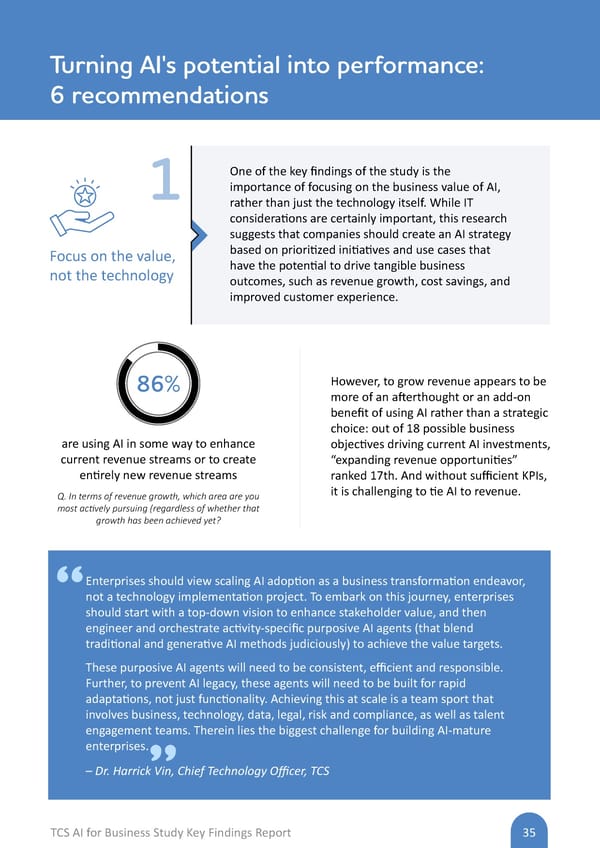
Turning AI's potential into performance: 6 recommendations 1 Focus on the value, not the technology One of the key findings of the study is the importance of focusing on the business value of AI, rather than just the technology itself. While IT considera�ons are certainly important, this research suggests that companies should create an AI strategy based on priori�zed ini�a�ves and use cases that have the poten�al to drive tangible business outcomes, such as revenue growth, cost savings, and improved customer experience. 86% However, to grow revenue appears to be more of an a�erthought or an add-on benefit of using AI rather than a strategic choice: out of 18 possible business are using AI in some way to enhance objec�ves driving current AI investments, current revenue streams or to create “expanding revenue opportuni�es” en�rely new revenue streams ranked 17th. And without sufficient KPIs, it is challenging to �e AI to revenue. Q. In terms of revenue growth, which area are you most actively pursuing (regardless of whether that growth has been achieved yet? Enterprises should view scaling AI adop�on as a business transforma�on endeavor, not a technology implementa�on project. To embark on this journey, enterprises should start with a top-down vision to enhance stakeholder value, and then engineer and orchestrate ac�vity-specific purposive AI agents (that blend tradi�onal and genera�ve AI methods judiciously) to achieve the value targets. These purposive AI agents will need to be consistent, efficient and responsible. Further, to prevent AI legacy, these agents will need to be built for rapid adapta�ons, not just func�onality. Achieving this at scale is a team sport that involves business, technology, data, legal, risk and compliance, as well as talent engagement teams. Therein lies the biggest challenge for building AI-mature enterprises. – Dr. Harrick Vin, Chief Technology Officer, TCS TCS AI for Business Study Key Findings Report 35
 TCS AI for Business Study: Key Findings Report Page 34 Page 36