Energy & Resources
Less than 30 mins read | This report explores the application of AI in the energy and resources sector to enhance performance by design.
From potential to performance by design Energy & Resources Report TCS AI for Business Study
2 TCS AI for Business Study – Energy & Resources Report About the TCS AI for Business Study TCS surveyed senior executives at nearly 1,300 companies in 12 sectors across 24 countries, approximately half of which had annual revenues over US$5 billion . This report includes study findings from 90 survey respondents in the Energy & Resources industry , including 42 oil and gas companies and 48 mining companies. What’s driving AI implementations? How is AI redefining the Energy & Resources industry? How are employees, skills and roles shifting? What customer engagement AI trends are emerging? Where is AI strategy headed in Energy & Resources? Are business results aligning with aspirations?
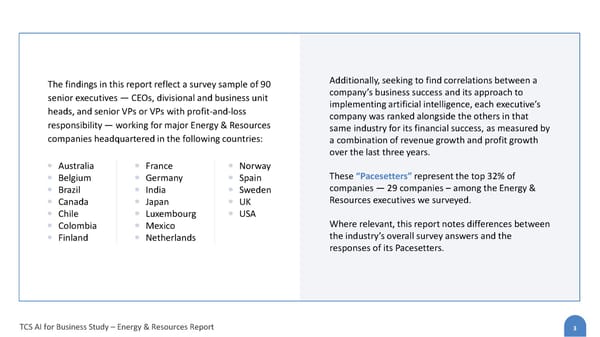
3 TCS AI for Business Study – Energy & Resources Report The findings in this report reflect a survey sample of 90 senior executives — CEOs, divisional and business unit heads, and senior VPs or VPs with profit-and-loss responsibility — working for major Energy & Resources companies headquartered in the following countries: Additionally, seeking to find correlations between a company’s business success and its approach to implementing artificial intelligence, each executive’s company was ranked alongside the others in that same industry for its financial success, as measured by a combination of revenue growth and profit growth over the last three years. These “Pacesetters” represent the top 32% of companies — 29 companies – among the Energy & Resources executives we surveyed. Where relevant, this report notes differences between the industry’s overall survey answers and the responses of its Pacesetters. Australia Belgium Brazil Canada Chile Colombia Finland France Germany India Japan Luxembourg Mexico Netherlands Norway Spain Sweden UK USA
The transformative potential of AI
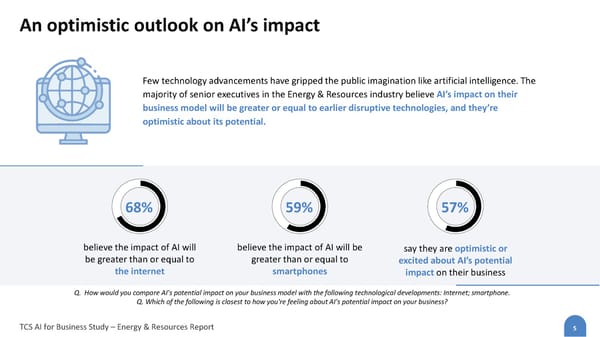
5 TCS AI for Business Study – Energy & Resources Report An optimistic outlook on AI’s impact Q. How would you compare AI's potential impact on your business model with the following technological developments: Internet; smartphone. Q. Which of the following is closest to how you're feeling about AI's potential impact on your business? Few technology advancements have gripped the public imagination like artificial intelligence. The majority of senior executives in the Energy & Resources industry believe AI’s impact on their business model will be greater or equal to earlier disruptive technologies, and they’re optimistic about its potential. 57% 59% 68% say they are optimistic or excited about AI’s potential impact on their business believe the impact of AI will be greater than or equal to smartphones believe the impact of AI will be greater than or equal to the internet
This is a modal window.
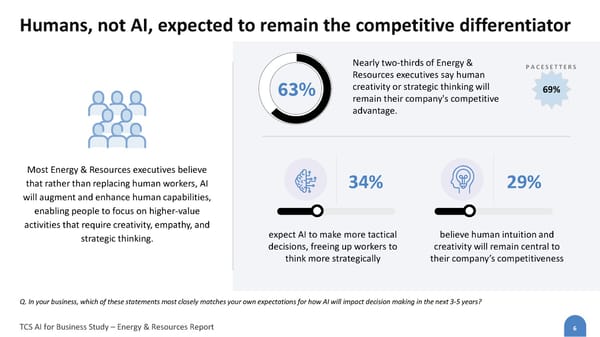
6 TCS AI for Business Study – Energy & Resources Report Humans, not AI, expected to remain the competitive differentiator Q. In your business, which of these statements most closely matches your own expectations for how AI will impact decision making in the next 3-5 years? Nearly two-thirds of Energy & Resources executives say human creativity or strategic thinking will remain their company's competitive advantage. expect AI to make more tactical decisions, freeing up workers to think more strategically believe human intuition and creativity will remain central to their company’s competitiveness Most Energy & Resources executives believe that rather than replacing human workers, AI will augment and enhance human capabilities, enabling people to focus on higher-value activities that require creativity, empathy, and strategic thinking. 63% 29% 34% 69% P A C E S E T T E R S
This is a modal window.
7 TCS AI for Business Study – Energy & Resources Report Executives want to innovate and make money with AI The Energy & Resources industry is more focused on using AI to spur innovation and grow revenue than are most other industries. On a 10-point scale between “optimization” and “innovation,” Energy & Resources executives averaged 6.90, compared to an average of 6.71 for all other industries. 52% 22% 15% 11% 57% 25% 11% 7% PACESETTERS Energy & Resources Focused on optimization, but with an eye toward innovation Solely or mostly focused on using AI to grow revenue and spur innovation Solely or mostly focused on using AI to lower costs and optimize operations Focused on innovation, but with an eye toward optimization Energy & Resources Pacesetters are even more focused on innovation: of respondents at Pacesetter organizations said they are primarily focused on innovation 82% said they are more interested in using AI to optimize operations and cut costs 18% Q. On a scale of 1 to 10 — where 1 is solely interested in using AI to lower costs and optimize operations and 10 is solely focused on spurring innovation and revenue growth — where would your company's current approach toward AI fall?
8 TCS AI for Business Study – Energy & Resources Report Most Energy & Resources executives are currently prioritizing productivity enhancement over quality improvement in their use of AI (albeit slightly less so than those in other industries). But over time, a more balanced approach to integrating AI – through optimization, productivity, innovation and quality – the better the outcomes across an enterprise. Productivity is an AI benefit, but quality will be its lasting value QQ. On a scale of 1 to 10 — where 1 is solely focused on using AI to improve quality and 10 is solely focused on using AI to enhance productivity — where would your company's current approach toward AI fall? On a 10-point scale between “improving quality” and “enhancing productivity,” Energy & Resources executives scored an average of 6.80, compared to the 6.91 average across other industries. The industry’s Pacesetters are even more focused on using AI to enhance productivity, however, with an average score of 7.21 on this scale. 51% 20% 16% 13% 54% 21% 18% 7% PACESETTERS Energy & Resources Focused on quality, but with an eye toward enhancing productivity Solely or mostly focused on using AI to enhance productivity Solely or mostly focused on using AI to improve quality Focused on productivity, but with an eye toward improving quality
9 TCS AI for Business Study – Energy & Resources Report Personalized interactions are top AI customer focus areas When it comes to customer engagement, organizations say they’re moving beyond commonplace chatbots. While chatbots for sales and product support remain important to Energy & Resources companies, their use is being supplanted by other AI-driven means to accomplishing these goals. 7% 24% 31% 34% 38% 36% 13% 3% Al-designed go-to-market strategies Gaining insights by analyzing customer behaviors and data More personalized, Al-driven interactions with our products/services themselves More personalized interactions/engagements for post-sales support (other than chatbots) More personalized interactions/engagements with our marketing initiatives (other than chatbots) Chatbots for product/service support Chatbots for marketing/sales support We are not exploring the use of Al in any customer interactions Q. In what ways are you exploring AI's impact on your relationships with customers? 17% P A C E S E T T E R S 34% P A C E S E T T E R S
The journey to AI
11 TCS AI for Business Study – Energy & Resources Report One size fits one? AI adoption strategies vary AI is not plug-and-play technology with a one-size-fits-all strategy, and the findings from Energy & Resources executives reflect their varied approaches to AI. More than a third favor establishing an enterprise-wide AI strategy – but a little over a quarter are content to hold back and see how others in their industry apply the technology before making any major moves. Q. Rank three areas in order of importance to your company's leadership regarding the use of AI in the enterprise. want to establish an enterprise-wide Al strategy to maximize its benefits to the company 34% 18% 26% 22% want to stay true to their purpose and success model in exploring how they might leverage Al want to experiment and take risks with Al to maximize its benefits want to wait and see how Al gets used in their industry and follow the lead of others
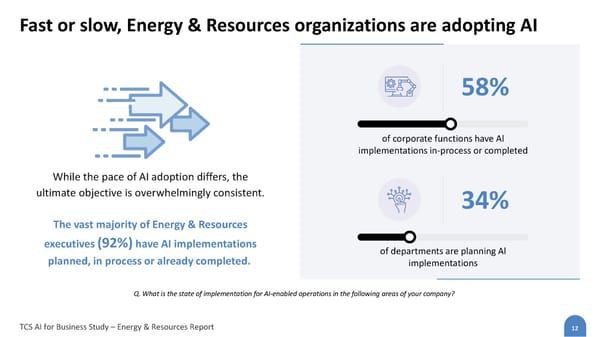
12 TCS AI for Business Study – Energy & Resources Report Fast or slow, Energy & Resources organizations are adopting AI Q. What is the state of implementation for AI- enabled operations in the following areas of your company? While the pace of AI adoption differs, the ultimate objective is overwhelmingly consistent. The vast majority of Energy & Resources executives (92%) have AI implementations planned, in process or already completed. of departments are planning Al implementations 34% of corporate functions have Al implementations in-process or completed 58%
This is a modal window.
13 TCS AI for Business Study – Energy & Resources Report A gap between aspiration and reality Q. L ooking at your organization overall, which most closely describes your company's current relationship to AI? The merging of reasoning and recognition intelligence into generative models offers tremendous potential to help companies reimagine entire value chains and transform the way they do business . But most Energy & Resources respondents say they have a long way to go to realize these outcomes. are cleaning up their data and moving it to the cloud 31% haven’t even moved beyond the initial AI exploration phase 23% say it’s currently a differentiating factor for business transformation Only 3%
14 TCS AI for Business Study – Energy & Resources Report What’s hampering AI progress? Energy & Resources executives say industry standards and regulations , their current IT infrastructure , and their own corporate culture are slowing their overall AI efforts. Q. What are the top 3 challenges to making effective use of AI in your company? Industry standards/regulations Company culture Current IT infrastructure Customers’ expectations Current IT service providers Current IT infrastructure 1st 3rd 2nd Energy & Resources All others
15 TCS AI for Business Study – Energy & Resources Report Generative AI brings its own set of challenges 46% of Energy & Resources executives surveyed expect up to half of their employees to be using GenAI on a daily basis within the next 3 years . And they said GenAI has prompted them to prioritize AI applications that enhance the overall customer experience. Q. In three years, what percentage of your employees do you believe will be using/interacting with Generative AI capabiliti es on a daily basis? Q. Rank the top 3 statements, which most closely reflect how recent attention to Generative AI (specifically) has changed you r c ompany's assessment of AI's benefits and risks more generally Energy & Resources All others Top ranked GenAI adoption concerns Redesigned customer experiences Security and privacy focus 1st Cultural shifts Ethical and responsible AI use Shift towards automation and efficiency Lack of IT readiness Increased investment in AI research and development Increased focus on talent development and training Ethical and responsible AI use Cultural shifts 2nd 3rd 4th 5th
Balancing risk with opportunity
17 TCS AI for Business Study – Energy & Resources Report Making way for AI Introducing such powerful technology into organizations comes with a great weight of responsibility. Extensive preparation and stringent governance that foster trust in outcomes and investment values must go hand in hand with AI adoption. Energy & Resources businesses are not only aware of the changes involved, but actively planning for them. Q. Have you given any thought to how your company's strategic direction needs to be revised due to AI's potential benefits or risks for your organization or your industry? of Energy & Resources companies are currently reworking or are planning to rework how they operate across the enterprise 76%
18 TCS AI for Business Study – Energy & Resources Report Homegrown implementation prevails for now Q. On a scale of 1 to 5, how much are you relying on external vendor and partnerships (including academic or government partn ers ) for your AI implementations and how much are you doing in-house?; Q. Are you planning to create your own enterprise- specific LLMs for use in Generative AI implementations? 60% 49% As AI preparation turns to implementation, organizations face numerous decisions to achieve the right mix of artificial intelligence and investment. Despite the complexity, nearly half of Energy & Resources companies are likely to rely on internal teams to develop and implement AI — even for tasks as difficult as creating their own enterprise-specific large language models (LLMs). say they are relying solely or mostly on in-house talent to implement this new technology plan to create their own enterprise-specific LLMs for use in GenAI implementations – 10 points higher than in other industries 41% P A C E S E T T E R S 62% P A C E S E T T E R S
19 TCS AI for Business Study – Energy & Resources Report Implementation metrics fall short Energy & Resources executives say they need better KPIs to measure the success of their AI implementations. Without KPIs, organizations will struggle to demonstrate AI’s value and gain internal traction for its adoption. Only 20% say they have “good enough” metrics and KPIs for their current stage of AI deployment. 7% said they aren’t even aware of any useful metrics for AI implementations. Q. Which statement most closely matches how you feel about measuring the success of and financial return on AI implementations? need both 18% need better non-financial KPIs for Al-enabled operations 27% need better financial KPIs for Al-enabled operations 29% 73% say they need better metrics to measure the success of their Al implementations 66% P A C E S E T T E R S
20 TCS AI for Business Study – Energy & Resources Report Navigating ethical, security and privacy dimensions The debut of sophisticated AI applications has intensified the focus on security and privacy concerns, and the ethical dimensions of AI use have also garnered significant attention. Most senior Energy & Resources executives prefer global standards, debating whether specific use cases are better covered at this scale or more locally. Q. Which regulatory landscape is most appropriate for your business's use of AI? 2% think it's too early or unnecessary to regulate Al 16% prefer a heterogenous environment of local regulations 38% prefer global Al standards, plus specific regional controls 44% prefer global Al standards regulating specific use cases and outcomes 38% P A C E S E T T E R S 52% P A C E S E T T E R S
21 TCS AI for Business Study – Energy & Resources Report A regulatory partnership between industry and government A majority of Energy & Resources executives think regulations should be jointly established between industry voices and government agencies. Close to half also think academic expertise deserves a seat at the table given how complex this technology already is and how quickly it is evolving. Q. Which organizations should be involved in establishing regulations about AI? Academia 49% Industry 63% Government 61% 48% P A C E S E T T E R S 69% P A C E S E T T E R S 55% P A C E S E T T E R S NGOs 21%
22 TCS AI for Business Study – Energy & Resources Report TCS recommendations Based on this research, here are our recommended next steps. Embrace an AI strategy based on prioritized initiatives and use cases that have the potential to drive tangible business outcomes. Focus on the business value, not the technology Invest not only in the necessary technology and infrastructure but in a culture that embraces change, experimentation, and continuous learning. Make your business & culture AI-ready Consider the broader strategic value of AI initiatives and how they can be used to improve operational efficiency, reduce risk, and enhance decision-making — all of which can contribute to overall business performance. Adopt a more strategic approach Let business and IT staffs focus on core competencies and strategic objectives, seeking partnerships and external expertise where appropriate, rather than shouldering the entire burden of AI implementation internally. Don’t go it alone Implement AI with the goals of expanding revenue, opportunity, and innovation, which offers the potential to create new jobs and enhance human capabilities. Plan for success, not scarcity Leverage more modern AI to deliver highly personalized, proactive and more value- added experiences across the customer journey for competitive differentiation and to build long-term loyalty. Create higher-level relationships with customers
23 TCS AI for Business Study Demographics: revenue and roles Energy & Resources n = 90 SVP/VP (P&L responsibility) Unit/divisional head CEO Role representation $100bn+ $5bn to $100bn $1bn to $5bn Revenue representation (in USD) 48% 48% 4% 10% 36% 54%
24 TCS AI for Business Study – Energy & Resources Report Demographics: 24 countries represented in the study United States Canada Mexico United Kingdom Ireland Germany /Austria Switzerland France Netherlands Denmark Spain Luxembourg Belgium Norway Sweden Finland India Australia New Zealand Japan Colombia Brazil Chile Total = 1,272 Energy & Resources = 90 Note: All countries except for Austria, Denmark, Ireland, New Zealand, and Switzerland included in the Energy & Resources sample
25 TCS AI for Business Study – Energy & Resources Report Demographics: 12 industries represented in the study Life Sciences Healthcare Energy & Resources Consumer Packaged Goods Communications, Media & Information Services Banks, Financial Services & Insurance Logistics Manufacturing Retail Technology Travel & Hospitality Utilities n = 1,272
26 Executive champions Dr. Harrick Vin Chief Technology Officer, TCS Abhinav Kumar Chief Marketing Officer, TCS Siva Ganesan Senior Vice President and Head, AI.Cloud, TCS Krishna Mohan Vice President and Deputy Head, AI.Cloud, TCS Sankaranarayanan “Shanky” Viswanathan Vice President and Head of Business Innovation, Chief Technology Office, TCS Nidhi Srivastava Vice President and Head of Offerings, AI.Cloud, TCS Suranjan Chatterjee Global Head of Engineering, AI.Cloud, TCS Ashok Krish Head, Advisory and Consulting, AI.Cloud, TCS Serge Vatin-Perignon Global Head, TCS Thought Leadership Institute Get more insights If you would like to get additional research based on the TCS AI for Business Study, visit on.tcs.com/2024-global-AI-study For more information or any feedback, email the TCS Thought Leadership Institute at TL.Institute@tcs.com The TCS AI for Business Study explores how companies around the world are looking at the strategic implications of AI technologies and how they are responding to its transformative potential. A survey of 1,272 senior executives with profit-and-loss responsibility at their companies was conducted November 28, 2023, through January 17, 2024, with responses from 24 countries across 12 industries, exploring the strategic implications of artificial intelligence and their expected impact on large, for-profit enterprises. Some data presented will not add up to one hundred percent due to rounding, and not every answer is included in the findings reported. About the Thought Leadership Institute Since 2009, the TCS Thought Leadership Institute has initiated conversations by and for executives to advance the purpose-driven enterprise. Through primary research, we deliver forward-looking and practical insights around key business issues to help organizations achieve long-term, sustainable growth. For more information, visit tcs.com/insights/global-studies For the most up-to-date content and news, download the TCS Perspectives app for your iOS and Android device. About Tata Consultancy Services Tata Consultancy Services is an IT services, consulting and business solutions organization that has been partnering with many of the world’s largest businesses in their transformation journeys for over 56 years. Its consulting-led, cognitive powered, portfolio of business, technology and engineering services and solutions is delivered through its unique Location Independent Agile™ delivery model, recognized as a benchmark of excellence in software development. A part of the Tata group, India's largest multinational business group, TCS has over 601,000 of the world’s best- trained consultants in 55 countries. The company generated consolidated revenues of US $29 billion in the fiscal year ended March 31, 2024, and is listed on the BSE and the NSE in India. TCS' proactive stance on climate change and award-winning work with communities across the world have earned it a place in leading sustainability indices such as the MSCI Global Sustainability Index and the FTSE4Good Emerging Index. For more information, visit www.tcs.com About the study