
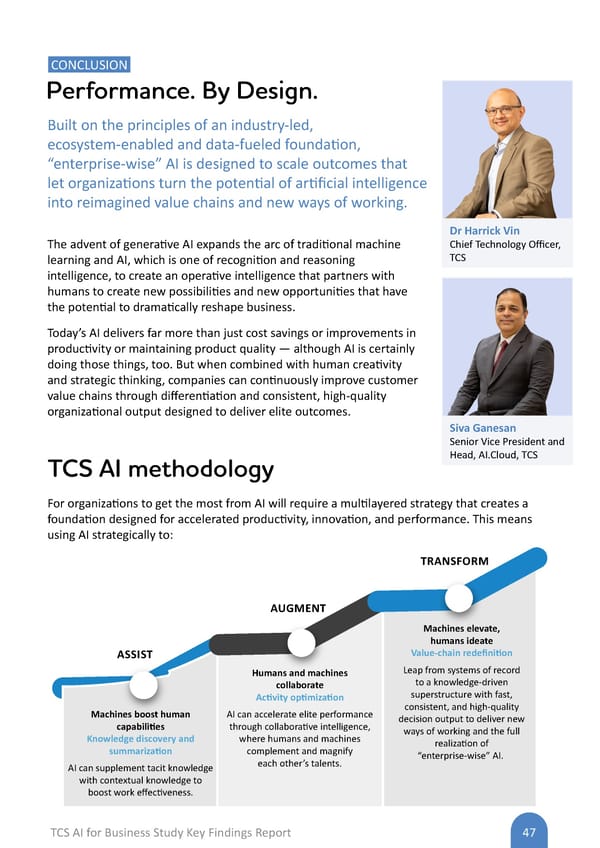
CONCLUSION Performance. By Design. Built on the principles of an industry-led, ecosystem-enabled and data-fueled founda�on, “enterprise-wise” AI is designed to scale outcomes that let organiza�ons turn the poten�al of ar�ficial intelligence into reimagined value chains and new ways of working. The advent of genera�ve AI expands the arc of tradi�onal machine learning and AI, which is one of recogni�on and reasoning intelligence, to create an opera�ve intelligence that partners with humans to create new possibili�es and new opportuni�es that have the poten�al to drama�cally reshape business. Today’s AI delivers far more than just cost savings or improvements in produc�vity or maintaining product quality — although AI is certainly doing those things, too. But when combined with human crea�vity and strategic thinking, companies can con�nuously improve customer value chains through differen�a�on and consistent, high-quality organiza�onal output designed to deliver elite outcomes. TCS AI methodology For organiza�ons to get the most from AI will require a mul�layered strategy that creates a founda�on designed for accelerated produc�vity, innova�on, and performance. This means using AI strategically to: Dr Harrick Vin Chief Technology Officer, TCS Siva Ganesan Senior Vice President and Head, AI.Cloud, TCS 47 TCS AI for Business Study Key Findings Report ASSIST AUGMENT TRANSFORM Machines boost human capabili�es Knowledge discovery and summariza�on AI can supplement tacit knowledge with contextual knowledge to boost work effec�veness. Humans and machines collaborate Ac�vity op�miza�on AI can accelerate elite performance through collabora�ve intelligence, where humans and machines complement and magnify each other’s talents. Machines elevate, humans ideate Value-chain redefini�on Leap from systems of record to a knowledge-driven superstructure with fast, consistent, and high-quality decision output to deliver new ways of working and the full realiza�on of “enterprise-wise” AI.
 AI Flipbook | TCS AI for Business Study: Key Findings Report Page 46 Page 48